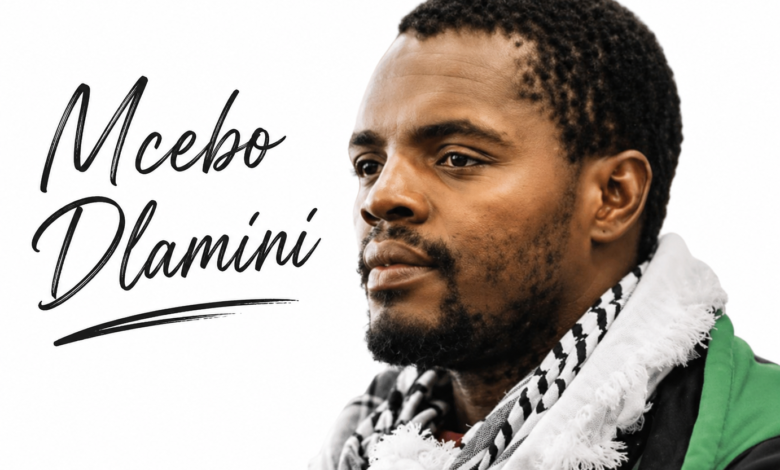
There is a certain kind of person who enters a room and rearranges it — not by asking permission, but by refusing to pretend the room is fine the way it is. Mcebo Dlamini is that kind of person. Whether you admire him or argue with everything he stands for, you cannot honestly say he passed through South African public life quietly.
From the barricades of a 2015 student protest to a corner office at one of the country’s most beloved football clubs, his story is not a straight line. It bends, doubles back on itself, and occasionally contradicts everything you thought you knew about him. That is what makes it worth telling properly.
Mcebo Dlamini Biography: The Full Picture
Full name: Mcebo Freedom Nkunzikayibaleki Dlamini Date of birth: 17 December 1986 Place of birth: Mbabane, eSwatini (formerly Swaziland) Nationality: Dual citizen — South African and eSwatini Occupation: Activist, politician, sports administrator Education: LLB, University of the Witwatersrand Political party: African National Congress (ANC) Current role: Chief Administrator, Orlando Pirates FC (appointed January 2026)
How Old Is Mcebo Dlamini?
Born on the 17th of December 1986, Mcebo Dlamini is currently 39 years old. He turned 39 in December 2025. His birth in Mbabane, the capital of eSwatini, gives him a background shaped by two countries — a detail that has followed him, both legally and personally, throughout his adult life.
Where Are the Dlamini Originally From?
The Dlamini surname is one of the most prominent in Swazi royal and noble lineages. It is historically tied to the Swazi kingdom, and many who carry the name trace roots to eSwatini. In Mcebo’s case, his mother, the late Witness Nkosingiphile Dlamini, was from KwaZulu-Natal in South Africa. He was raised in eSwatini by his aunt, Sichenge Nomkhosi, and her husband, Ntshintshabantu Dlamini. His paternal roots remain one of the more contested parts of his biography — more on that below.
Mcebo Dlamini’s Parents: A Complicated Story
The question of parentage sits at the centre of some of Mcebo Dlamini’s most talked-about controversies.
His mother was the late Witness Nkosingiphile Dlamini, a South African woman originally from KwaZulu-Natal who passed away in 2018. Mcebo has cited her death as the reason he fell out of compliance with South African immigration requirements.
His father’s identity, however, became a subject of significant public debate during his time at Wits. For a period, he publicly positioned himself as the child of Zwelakhe Sisulu — son of struggle legend Walter Sisulu — and even went so far as to describe himself as a lovechild of Zwelakhe and a Swazi princess. He introduced himself on multiple occasions as Mcebo Olyate Sisulu and spoke openly of childhood memories in the Sisulu home in Orlando West.
The Sisulu family disputed this firmly. Max Sisulu, brother of the late Zwelakhe, stated categorically that no one in the family knew any Mcebo. When pressed directly by journalists, Mcebo eventually admitted the truth: his name was Mcebo Freedom Dlamini, and the Sisulu connection was what he himself described as a “stage name” he used when he was “excited.” He confirmed he has no blood relation to the Sisulu family.
It was a strange, revealing episode — less about dishonesty and more about a young man’s complicated desire to anchor himself in the lineage of the liberation struggle.
Mcebo Dlamini’s Education
Mcebo was admitted to study law at the University of the Witwatersrand (Wits) in 2012, gaining entry on a student visa. His fees were sponsored by the Gauteng Provincial Government.
He pursued an LLB — a Bachelor of Laws — at one of South Africa’s most academically respected institutions. The irony is that his criminal record, following his 2020 conviction, has effectively closed the door on a legal career. The qualification he worked toward, and protested for others to access freely, became one he cannot professionally use.
During his time at Wits, his Facebook profile claimed he also held degrees in Nuclear Physics and Actuarial Science, with a story attached that the University of Pretoria had secretly recruited him for the physics programme. Both claims were false. His supporters were largely unmoved by the revelation — which said something interesting about why people backed him in the first place.
The FeesMustFall Years: Why Mcebo Dlamini Matters
To understand Mcebo Dlamini, you have to understand 2015.
The South African government announced a proposed increase in university fees that year. For many students — first-generation university attendees, children of domestic workers and mineworkers, young people carrying the economic weight of an apartheid system their parents had survived — this was not an administrative matter. It was a signal that the promise of post-1994 South Africa remained a promise only.
Students at institutions across the country mobilised under the hashtag #FeesMustFall. At Wits, Mcebo Dlamini was the SRC president, and he became the face of the protest at the national level. His speeches were watched and shared. His willingness to stand directly in front of power — and name it — made cameras follow him.
When the government announced a zero percent fee increase, tears ran down his face in public. It was the kind of moment that people either found deeply human or deeply theatrical, depending on what they already thought of him. Probably it was both.
His lasting quote from that period: “The ANC must stop being arrogant and implement free higher education for the poor.”
The movement’s long-term consequence was real: it contributed directly to the introduction of free tertiary education for qualifying low-income students in South Africa — a structural shift that has benefited tens of thousands of young people since.
The Controversies That Followed Him
The Hitler Comments
In April 2015, Mcebo Dlamini posted on Facebook that he loved Adolf Hitler, alongside a graphic comparing modern Israel to Nazi Germany. He also wrote that “in every white person there is an element of Adolf Hitler.” His stated reasoning was that Hitler targeted white people while other leaders had historically targeted Black people.
The outcry was significant and swift. The South African Jewish community lodged complaints with the Human Rights Commission. Wits Vice Chancellor Professor Adam Habib condemned the remarks publicly. Mcebo was subsequently suspended from the SRC presidency — a suspension that eventually became a full removal from the position.
His defenders argued the comments were deliberately provocative rather than genuinely antisemitic. His critics argued that the provocation itself caused harm regardless of intent.
In December 2020, Mcebo issued a formal apology to the SA Jewish Board of Deputies. He acknowledged that his 2015 statements were offensive and ill-advised, and that in hindsight, he recognised the trauma they caused. He attended a facilitated engagement at the Johannesburg Holocaust and Genocide Centre. The SAJBD noted that his acknowledgement of the hurt he caused came across as genuine.
Whether you read that apology as transformation or as calculated political rehabilitation ahead of an ANC career, the fact that he made it at all was notable. Many in comparable positions never do.
The Arrests and Sentencing
During the 2016 FeesMustFall protests, Mcebo Dlamini was arrested and faced six charges: public violence, assault of a police officer, malicious damage to property, theft, unlawful presence in the country, and violation of a court order.
He was denied bail — a decision that triggered further protests at Wits.
On 9 March 2020, he appeared at the Johannesburg Magistrate’s Court and pleaded guilty to two of the six counts. He received two years, wholly suspended for five years, for public violence on 4 October 2016. He also received six months, wholly suspended for five years, for remaining in South Africa unlawfully. He avoided imprisonment, but gained a criminal record that ended his path to practising law.
Mcebo Dlamini’s Marriage and Personal Life
This is the part of the Mcebo Dlamini biography where the public record goes quiet.
He has not publicly confirmed a long-term partner or children as of 2026. No marriage announcement, no confirmed relationship, nothing in the public record that firmly establishes a family life. He has kept that side of himself away from cameras and press in a way that contrasts sharply with how visible everything else about him has been.
If that changes, it will likely make news. For now, his personal life remains genuinely private.
Mcebo Dlamini’s Career: From Campus to Orlando Pirates
Mcebo Dlamini’s career has moved through three distinct phases.
Phase one was student politics. He was elected chair of the Wits Junction Residence Committee in November 2013, then elected SRC president in November 2014. During that period, he became nationally visible through the FeesMustFall movement in 2015.
Phase two was the long legal battle and continued public advocacy. Between 2016 and 2020, while his court case wound through the justice system, he never fully stepped off the public stage. He wrote political commentary for publications including CityPress, News24, and the Mail & Guardian — pieces covering economic transformation, the politics of race and class, and the legacy of apartheid. In August 2019, he walked 56.6 kilometres from Wits to the Union Buildings in Pretoria to advocate for the release of student activists who had been imprisoned during the FeesMustFall protests. The gesture was politically intentional and physically demanding.
Phase three arrived in January 2026, when Orlando Pirates FC announced his appointment as Chief Administrator. Orlando Pirates — the Buccaneers — is one of the most storied football clubs in South Africa. His transition from campus activist to club administrator surprised people who had tracked his trajectory. According to sources quoted in the football press, he has earned respect within the club for a different kind of approach. “You can see during games how much the players respect him,” one source noted.
From the frontlines of a student protest to the boardroom of a Premier Soccer League club — it is either the most unlikely career arc in South African public life, or simply a reflection of how adaptable intelligence tends to find its level.
What Mcebo Dlamini’s Story Actually Says
His critics will always have material to work with. The lies about the Sisulu lineage. The Hitler comments. The false credentials. These are not footnotes — they were significant, and people were genuinely hurt by some of them.
But the version of the story that flattens everything into scandal misses what is actually interesting: that this is a man who came from eSwatini with a student visa, enrolled at Wits on provincial funding, helped force a national policy change on higher education, faced a four-year legal ordeal, made a public apology he did not have to make, and has now found a second act in sport administration.
South Africa tends to produce figures who carry both their potential and their damage at the same time. Mcebo Dlamini is one of those figures — and whatever your verdict on the choices he made, the question his story keeps asking is worth sitting with: what does it take to change something in this country, and what does changing something cost the person who tries?
Sources: Wits Vuvuzela, TimesLive, News24, Mail & Guardian, SA Jewish Report, Soccer Laduma